ChatGPT
 Perplexity AI
 Claude
A strong interior designer resume can show you exactly how to turn your creativity, technical skills, and real-world projects into a job-winning application. This in-depth guide is packed with practical tips, clear examples, inspiring resume samples, and professional templates to help you present your design experience in a way that hiring managers instantly understand.
Just like a successful interior project, a great resume is all about balance between creativity and structure, aesthetics and clarity. Follow this guide, and you’ll learn how to highlight your design expertise, showcase your completed projects, and format your resume so both recruiters and ATS systems can see your value at a glance.


 See more examples like these
In this guide, you’ll learn:
- What works (and what doesn’t) in real-life interior designer resume samples
- How to pick the right resume format as an interior designer
- How to format your interior designer resume (and keep it ATS-friendly)
- How to choose between a resume summary and a resume objective
- How to select the most relevant skills for an interior designer role
- How to present your work experience and design achievements effectively
- How to use strong action verbs to describe your design work
- How to write the education section professionally
- Which optional resume sections can help you stand out as a designer
- Common resume mistakes interior designers should avoid
- How to create a matching interior designer cover letter
- Where to find the best resources for interior designer job-seeking
Still looking for your next job opportunity? Kickresume can help you create a polished interior designer resume and guide you through everything you need to get hired faster.
Interior designer consultant resume sample


What works
- Professional and clear layout: The resume is easy to scan, with distinct sections for Summary, Experience, Skills, Education, and Certifications. This improves readability for both human recruiters and ATS systems, ensuring key details aren’t missed.
- Targeted summary that sets context: The opening summary gives a quick snapshot of the candidate’s experience and focus in interior design consulting, which helps frame the rest of the resume from the start.
- Relevant technical skills and tools highlighted: The Skills section includes key tools and proficiencies (like AutoCAD, SketchUp, Revit, client communication) that are directly relevant to interior design consulting roles. These keywords are often looked for in both ATS filters and recruiter scans.
What could be improved
- Experience section lacks measurable outcomes: Many of the bullet points describe duties without showing the impact of the candidate’s work (e.g., client satisfaction, cost savings, design improvements, project completion rates). Adding specific results or measurable achievements would show real value.
- Generic project descriptions: The experience entries talk about general responsibilities (“worked with clients,” “coordinated designs”) without context about the scale, type, or uniqueness of the projects (residential vs. commercial, small vs. large budget, etc.). Detail adds credibility.
- Soft skills and consultancy strengths are underrepresented: Consulting roles rely heavily on communication, client relationship management, and problem-solving. These should be woven into experience bullet points or highlighted in a distinct soft skills section to make the profile more well-rounded.
Interior designer resume sample

What works:
- Clear structure & essential sections: It includes all core resume sections (Profile, Work Experience, Education, Skills, Hobbies, Volunteering), giving a full overview of the candidate’s background and relevant experience.
- Relevant technical skills listed: The skills section shows proficiency in key design programs like AutoCAD, 3ds Max, Revit, SketchUp, and Photoshop — tools that employers expect for interior design roles.
- Shows hands-on experience across roles: The work history covers multiple design-related positions, including interior design, architecture, and freelance work, suggesting exposure to various project types and practical environments.
What could be improved
- Profile section lacks clarity and customization: The opening paragraph is vague and unfocused (“Innovation in design … effective working relationships”) and doesn’t clearly sell the candidate’s value, design focus, or key accomplishments. More tailored, metric-driven language would make it stronger.
- Work experience lacks details & achievements: Most bullet points are generic (e.g., “Design and Redesign,” “Interior Design for flats and villas”) without concrete results, project scale, tools used, or responsibilities explained. Adding specifics would help recruiters understand impact.
- Hobbies section is too generic and adds little professional value: Including general interests like Reading Books, Music, Sport, etc. doesn’t improve the resume’s design credibility. Focus on more relevant professional activities (design competitions, portfolio showcases).
Architect resume sample

What works
- Strong layout with clear sections: The resume has a clean, professional structure with clearly defined sections for Profile, Work Experience, Skills, Education, and Certifications, making it easy to scan for both ATS and human reviewers.
- Relevant technical and design skills listed: The Skills section highlights in-demand tools for architects (AutoCAD, Revit, SketchUp, Rhino, Microsoft Office), showing that the candidate has the technical foundation most firms look for.
- International & multidisciplinary experience shown: The work history demonstrates a mix of architectural roles (Design, Drafting, Construction Admin), suggesting adaptability and exposure to various stages of project delivery, which is a positive signal for hiring managers.
What could be improved
- Profile section isn’t impactful or specific: The personal summary is quite generic and doesn’t immediately convey the candidate’s unique strengths, design focus, or measurable achievements. Tailoring this to specific architectural environments (e.g., commercial, residential, urban design) would make it more compelling.
- Work experience entries lack measurable results or context: The bullet points mainly describe tasks (“Prepared architectural drawings,” “Participated in design process”) without clear outcomes, project scale, or tools used. Including quantifiable impact (project size, client satisfaction, budget parameters) would strengthen each entry.
- Soft skills and design philosophy are missing: While technical skills are present, the resume doesn’t include soft skills or narrative elements that show how the architect collaborates, communicates with clients, leads teams, or contributes to design strategy. Adding these, ideally supported by examples, would make the profile more well-rounded.
1. How to pick the right interior designer resume format
There are multiple options available when you’re choosing a resume format. Before you start creating your interior designer resume, it’s important to decide which format works best for your background and career goals.
Each resume format highlights different aspects of your profile. As an interior designer, your choice should reflect whether you want to emphasize hands-on design experience, technical skills, creative projects, or career progression.
Here are the three main resume formats and how they work for interior designers:
Reverse-chronological resume (a.k.a. traditional resume)
The reverse-chronological format places your work experience front and center, starting with your most recent role. It’s the most commonly used resume format and works especially well for interior designers with professional experience.
It’s ideal if you’ve:
- Worked on real client projects (residential, commercial, hospitality, etc.)
- Progressed from junior to mid-level or senior design roles
- Gained increasing responsibility for budgets, clients, or project management
This format makes it easy for employers to see where you’ve worked, what type of spaces you’ve designed, and how your career has evolved.
Functional resume (a.k.a. skills-based resume)
A functional resume format focuses on skills, tools, and areas of expertise rather than job titles or timelines.
This format can be useful if:
- You’re a recent interior design graduate or student
- You’re changing careers and transitioning into interior design
- Your experience consists mainly of academic projects, internships, or freelance work
It allows you to highlight design-related skills such as space planning, CAD software, material selection, and visual presentation, even if your work history is limited.
Hybrid resume (a.k.a. combination resume)
The hybrid resume combines both approaches. It highlights your key design skills and strengths at the top, followed by a clear and structured work experience section.
This format is often a great choice for interior designers who:
- Have a mix of internships, freelance projects, and full-time roles
- Want to showcase both creative and technical abilities
- Need space to highlight software proficiency, design concepts, and project work
Matching resume formats to interior design career levels
- Interior design students or recent graduates: If you’re just starting your career and don’t yet have extensive professional experience, a hybrid or functional resume can help you emphasize academic projects, internships, design tools, and core skills, even if your job titles are limited.
- Junior or mid-level interior designers: Once you’ve worked on real-world projects, a reverse-chronological resume is usually the strongest option. It clearly shows your experience, responsibilities, and the types of environments you’ve designed.
- Senior interior designers or design leads: If you have several years of experience, lead projects, or manage client relationships, a reverse-chronological or hybrid format works best. You can combine a strong work history with a skills section that highlights leadership, project coordination, and collaboration with architects and contractors.
Pro tip
If you’re applying through an Applicant Tracking System (ATS), go with the reverse-chronological format whenever possible. Many ATS tools struggle with purely functional resumes, which can cause important information to be missed.
However, always read the job posting carefully. If an employer specifically asks for a traditional resume format, stick with reverse-chronological, even if you’re early in your interior design career.
Try our AI Resume Writer and have your resume ready in minutes!

2. How to format your interior designer resume (and keep it ATS-friendly)
Choosing the right resume format is only half the battle. Even the most visually impressive interior designer resume can fail if it’s poorly formatted or unreadable for Applicant Tracking Systems (ATS).
While interior design is a creative field, many studios, architecture firms, and larger companies still use ATS software to screen resumes before a hiring manager ever sees them. That’s why your resume needs to balance clean design with technical readability.
Follow these resume formatting basics
To keep your interior designer resume professional, scannable, and ATS-friendly, stick to these formatting rules:
- Use a simple, one-column layout: Multi-column designs, tables, or text boxes may look visually appealing, but they can confuse ATS software and cause key information (like skills or experience) to be skipped.
- Choose a readable font: Stick to clean, professional fonts such as Arial, Calibri, Helvetica, or Times New Roman. Decorative or handwritten-style fonts might fit your design aesthetic, but they reduce readability and ATS compatibility.
- Keep font sizes consistent: Use 10.5–12 pt for body text and 14–16 pt for section headings. This makes your resume easy to scan for both recruiters and automated systems.
- Use standard section headings: Creative labels may look original, but ATS systems recognize common headings best. Use clear titles like:
- Work Experience
- Skills
- Education
- Certifications
- Use bullet points instead of long paragraphs: Bullet points improve readability and help ATS tools correctly identify individual responsibilities, tools, and achievements.
- Stick to PDF or DOCX formats: These file types are the safest choice for ATS parsing. If the job posting specifies a format, always follow that instruction.
How to optimize your interior designer resume for ATS scanners
ATS software doesn’t “read” resumes the way people do. It scans them for keywords and compares them to the job description.
To improve your chances of passing the ATS stage:
- Mirror keywords from the job posting: If the job ad mentions “space planning,” “AutoCAD,” “Revit,” “client presentations,” or “material selection,” use the same wording naturally in your resume.
- Include role-specific interior design terms: Interior designer resumes often perform better when they include keywords such as:
- Space planning
- Concept development
- AutoCAD / Revit / SketchUp
- FF&E selection
- Client presentations
- Construction documentation
- Material and finishes specification
- Avoid graphics, icons, and rating bars: Skill bars, icons, or visual proficiency charts may look modern, but many ATS systems can’t interpret them correctly.
- Don’t hide keywords: Using white text, invisible sections, or keyword stuffing can backfire and may result in your resume being filtered out.
- Always use a clear job title: Many ATS systems and recruiters search resumes by job title. If your official title was non-standard, add a more common equivalent in brackets
(e.g. Design Assistant (Junior Interior Designer)), so your role is immediately clear.
Use ATS-friendly templates to save time
Manually formatting a resume that looks good and works with ATS can be tricky, especially in a creative field like interior design.
That’s why many designers use ATS-friendly resume templates, which are already optimized for structure, readability, and keyword parsing.
Kickresume’s resume templates are designed to balance clean, modern design with ATS compatibility, so your interior designer resume passes automated scans while still appealing to human recruiters.
Find out your resume score!

3. How to differentiate between a resume summary and resume objective as an interior designer
The first major section on your interior designer resume should be a strong opening statement: either a resume summary or a resume objective.
Both serve the same purpose: to grab a recruiter’s attention immediately and give them a clear reason to keep reading.
Why does this matter so much?
Because recruiters don’t read resumes line by line. They skim, and often in just a few seconds. Your summary or objective is your chance to say:
“Here’s who I am as a designer, here’s what I bring to the table, and here’s why I’m worth a closer look.”
In just a few sentences (typically 3–5), you should highlight your design focus, key skills, and one or two concrete strengths or achievements. When done right, this section can be the difference between landing an interview and being overlooked.
So, which one should you use?
Writing a resume summary (for experienced interior designers)
A resume summary is the better choice if you already have hands-on experience in interior design. For example, if you’ve worked as an Interior Designer, Junior Interior Designer, or Senior Interior Designer on real client or commercial projects.
What should an interior designer resume summary include?
- Your professional title (e.g. Interior Designer, Residential Interior Designer, Commercial Interior Designer)
- Your years of experience
- Your design focus (residential, commercial, hospitality, workplace, retail, etc.)
- Key technical skills (AutoCAD, Revit, SketchUp, space planning, FF&E, etc.)
- One concrete achievement or type of project you’ve worked on
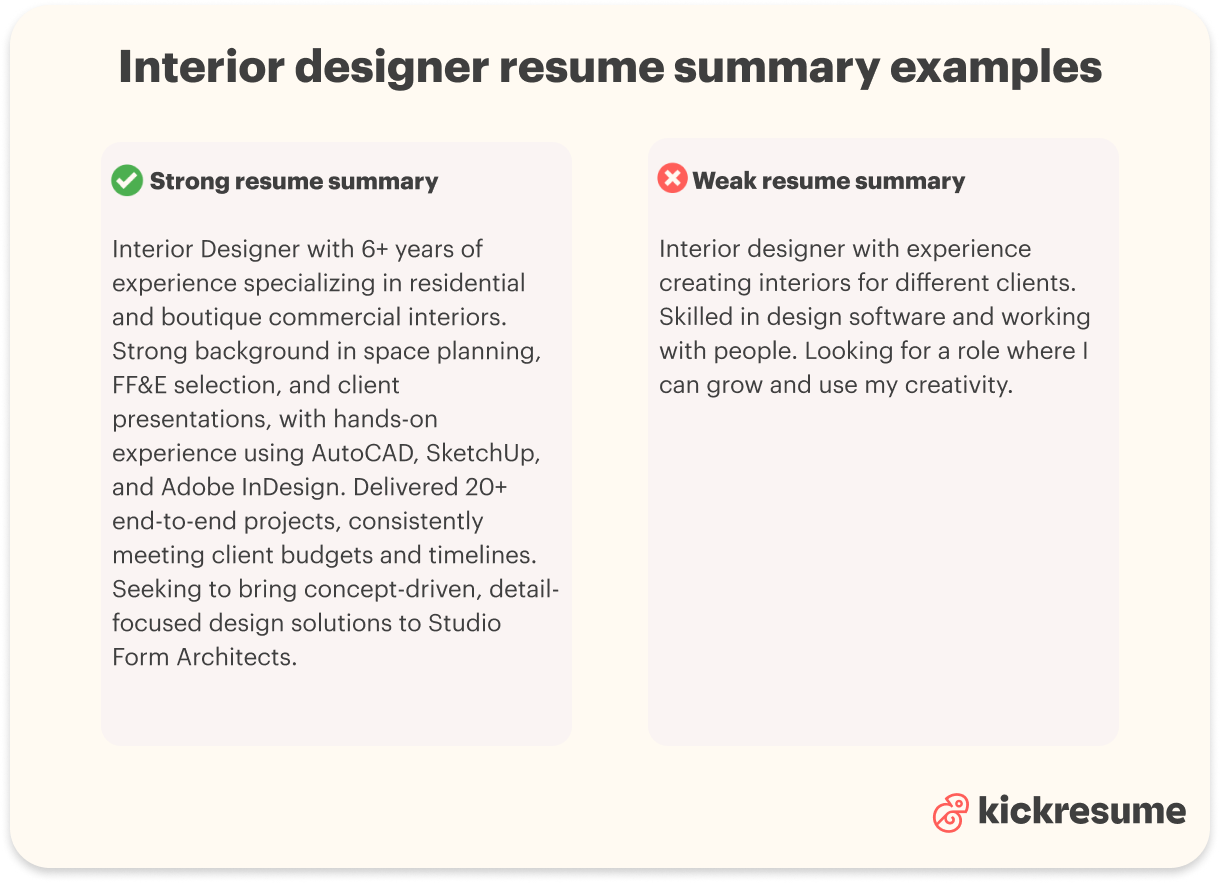
Bad interior designer resume summary example
Interior designer with experience creating interiors for different clients. Skilled in design software and working with people. Looking for a role where I can grow and use my creativity.
Why is this weak?
It’s vague, generic, and doesn’t show what kind of designer this person is. There’s no specialization, no tools, no project context, and nothing memorable.
Good interior designer resume summary example
Interior Designer with 6+ years of experience specializing in residential and boutique commercial interiors. Strong background in space planning, FF&E selection, and client presentations, with hands-on experience using AutoCAD, SketchUp, and Adobe InDesign. Delivered 20+ end-to-end projects, consistently meeting client budgets and timelines. Seeking to bring concept-driven, detail-focused design solutions to Studio Form Architects.
Why does this work?
It’s specific, clearly positions the designer’s expertise, mentions relevant tools, and shows real-world project experience. A recruiter instantly understands the designer’s level and focus.
Writing a resume objective (for students and junior interior designers)
A resume objective is a better option if you’re early in your interior design career, for example, if you’re a student, recent graduate, design assistant, or transitioning from a related field.
Instead of focusing on past achievements (which you may not have many of yet), a resume objective highlights your training, potential, and career direction.
What should an interior designer resume objective include?
- Your current status (student, graduate, junior designer, design assistant)
- The type of interior design role you’re targeting
- Relevant skills or software you already use
- Academic projects, internships, or practical training
- Your motivation to grow and contribute to a design team
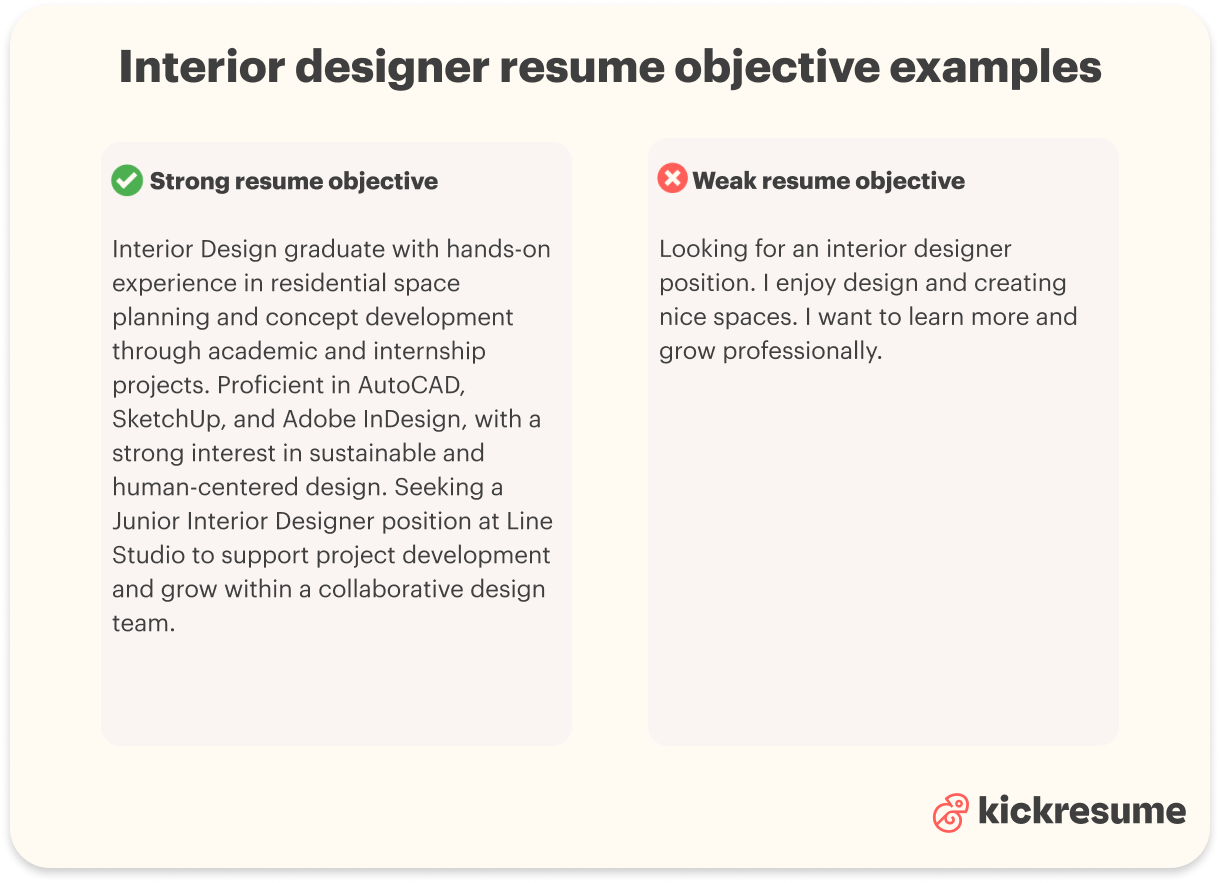
Bad interior designer resume objective example
Looking for an interior designer position. I enjoy design and creating nice spaces. I want to learn more and grow professionally.
What’s wrong here?
It’s too generic. There’s no indication of skills, tools, education, or design focus. Recruiters learn almost nothing about the candidate’s actual potential.
Good interior designer resume objective example
Interior Design graduate with hands-on experience in residential space planning and concept development through academic and internship projects. Proficient in AutoCAD, SketchUp, and Adobe InDesign, with a strong interest in sustainable and human-centered design. Seeking a Junior Interior Designer position at Line Studio to support project development and grow within a collaborative design team.
Why does this work?
It clearly states the candidate’s level, skills, tools, and design interest. Even without years of experience, the recruiter can see direction, relevance, and motivation.
Final tip
Whether you choose a resume summary or a resume objective, avoid empty buzzwords like “creative,” “passionate,” or “hard-working” unless you support them with specific skills, tools, or examples.
In interior design, clarity beats fluff. Let your projects, software skills, and design focus speak for you.
4. How to choose the right skills on your interior designer resume
In interior design, your skills are what truly differentiate you from other candidates with similar job titles. But that doesn’t mean you should list every tool, style, or technique you’ve ever encountered.
The key is relevance, and the job posting should always be your main guide.
Before you build your Skills section, ask yourself:
- Are they looking for strong technical execution (AutoCAD, Revit, construction documentation)?
- Do they emphasize concept development and creativity?
- Is the role more client-facing or more production-oriented?
- Are they hiring for residential, commercial, hospitality, or workplace projects?
The answers to these questions tell you which skills should take priority and which can stay in the background.
Interior designer resumes work best when they clearly show both design competence and real-world execution.
Top hard skills for an interior designer resume
Hard skills demonstrate that you can actually design, document, and deliver projects, not just talk about ideas.
Some valuable hard skills for interior designer resume
- Space planning and layout development
- AutoCAD (floor plans, sections, construction drawings)
- SketchUp or Rhino (3D modeling)
- Revit or BIM tools (for technical coordination)
- Adobe Creative Suite (InDesign, Photoshop, Illustrator)
- Concept development and mood boards
- FF&E selection and specification
- Material and finishes selection
- Construction documentation
- Budget awareness and basic cost estimation
These skills show that you understand the technical and practical side of interior design, from concept through execution.
Top soft skills for an interior designer resume
Interior design is not just about aesthetics, it’s also about communication, collaboration, and problem-solving.
Strong soft skills signal that you can work effectively with clients, architects, contractors, and internal teams.
Highly valued soft skills for interior designer resume
- Client communication and presentation skills
- Collaboration with architects, engineers, and contractors
- Time management and meeting deadlines
- Attention to detail
- Creative problem-solving
- Adaptability during design revisions
- Organization and project coordination
- Visual storytelling and explaining design decisions
- Openness to feedback and iteration
- Professional reliability and accountability
Interior designers sit at the intersection of creativity, technical precision, and people management. Your skill set should reflect all three.
Pro tip - Let the job ad shape your Skills section
If the job posting repeatedly mentions tools like AutoCAD, Revit, FF&E, or client presentations, make sure those exact terms appear in your resume, naturally and honestly.
This helps in two ways:
- Applicant Tracking Systems (ATS) recognize your resume as relevant
- Human recruiters instantly see that your profile matches their needs
A focused, tailored Skills section makes it much easier for employers to imagine you already working on their projects.
5. How to effectively list your achievements and work experience in an interior designer resume
Listing your job history is easy. Turning it into a compelling story is where most candidates struggle.
Your work experience section shouldn’t read like a list of tasks you were “responsible for.” Instead, it should clearly show:
- What types of projects you worked on (residential, commercial, hospitality, workplace)
- Your level of responsibility within the design process
- Who you collaborated with (clients, architects, contractors, internal teams)
- What impact your work had on the final outcome
Whenever possible, support your experience with specific results, even in design roles, impact matters.
Bad example of an interior designer work experience section
Interior Designer
XYZ Design Studio
June 2020 – Present
- Worked on interior design projects
- Created layouts and design concepts
- Selected materials and furniture
- Communicated with clients
- Helped with project coordination
What’s lacking here?
This description is vague and generic. It doesn’t tell the employer what kind of projects this designer worked on, what their real responsibilities were, or how they contributed to successful outcomes. There’s nothing here that helps a hiring manager distinguish this candidate from dozens of others.
Good example of an interior designer work experience section
Interior Designer
XYZ Design Studio, New York, NY
June 2020 – Present
- Designed and developed interior concepts for residential and small commercial projects, including apartments, offices, and retail spaces ranging from 800–4,000 sq. ft.
- Created detailed floor plans, elevations, and construction drawings using AutoCAD and SketchUp, ensuring smooth handoff to contractors and consultants.
- Collaborated closely with clients to translate functional needs and budget constraints into cohesive design solutions, maintaining a client satisfaction rate above 95%.
- Selected FF&E, finishes, and lighting solutions aligned with project budgets, contributing to an average cost variance of under 3%.
- Coordinated with architects, contractors, and suppliers throughout project execution, helping deliver projects on time and within scope.
Why is this better?
This version clearly shows the designer’s role, project types, tools used, and real impact. It combines responsibilities with outcomes and gives hiring managers a realistic picture of how this candidate operates in a professional design environment.
Tips for junior interior designers or candidates with limited experience
If you’re a junior designer, design assistant, or recent graduate, your experience section may look different, and that’s completely fine. The key is to frame your contributions clearly and confidently.
You can include:
- Studio internships or assistant roles
- University or thesis projects that mirror real-world design work
- Contributions to concept development, drawings, or presentations
- Collaboration with senior designers on live projects
- Client-facing tasks such as presentations or material sourcing
Good work experience entry example for a junior interior designer
Junior Interior Designer
Studio Forma, Chicago, IL
September 2022 – May 2024
- Assisted senior designers in developing interior concepts and mood boards for residential renovation projects.
- Produced floor plans, elevations, and 3D models in AutoCAD and SketchUp under design lead supervision.
- Prepared client presentation materials using InDesign and Photoshop, helping improve clarity and visual consistency across proposals.
- Researched materials, finishes, and furniture options, contributing to design libraries and sample boards.
- Supported project coordination by tracking revisions, organizing drawings, and communicating updates with internal teams
Final tip
Your work experience section should tell a story of contribution and growth, not just attendance.
Think about:
- Where you helped projects move forward
- How your design decisions solved problems
- What you improved, clarified, or delivered
Then build your bullet points around those moments. That’s what makes an interior designer resume feel confident, credible, and hire-ready.
6. How to select the right action verbs for your interior designer resume
Action verbs are small words with a big impact. They turn your bullet points from passive descriptions into clear, confident statements about how you design, collaborate, and deliver results.
In creative roles like interior design, wording matters even more. The verbs you choose can subtly signal whether you take ownership, solve problems, and contribute creatively, or whether you simply “assist” and “help.”
Compare the difference:
No action verbs included
Responsible for creating interior layouts and selecting materials.
vs.
Action verbs included
Designed functional layouts and curated material palettes that aligned with client needs and project budgets.
The outcome: Same work. Much stronger impression.
Why action verbs matter in interior design resumes
Interior designers are expected to balance creativity with execution. Your resume should reflect that you don’t just have ideas, but also that you develop, refine, and implement them.
Strong action verbs help you show that you:
- Actively shape design decisions
- Collaborate across disciplines
- Translate concepts into real, buildable solutions
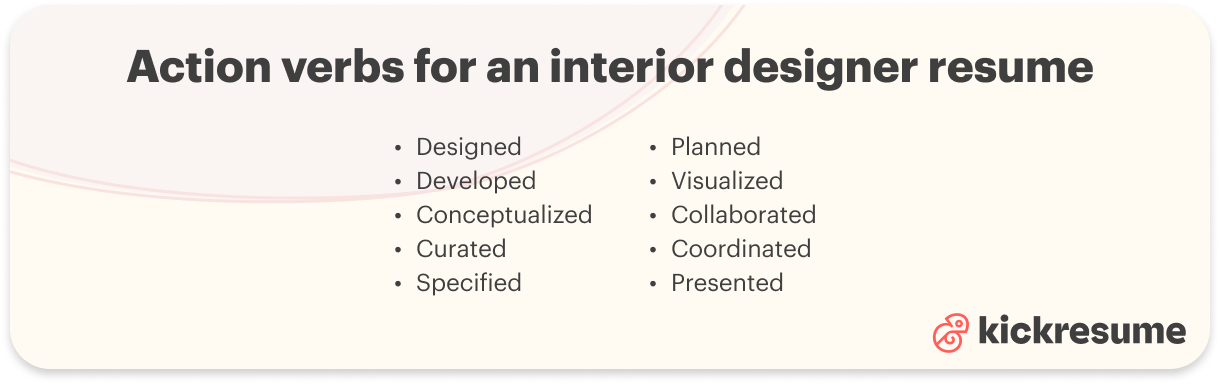
Effective action verbs for an interior designer resume
- Designed
- Developed
- Conceptualized
- Curated
- Specified
- Planned
- Visualized
- Collaborated
- Coordinated
- Presented
If used naturally, these verbs signal that you’re hands-on in the design process, from early concepts to final delivery.
See the difference action verbs make
Before adding action verbs
- I was responsible for creating interior design concepts.
- I helped with selecting furniture and materials.
- I worked with clients and contractors during projects.
After adding action verbs
- Developed interior design concepts and mood boards for residential and commercial projects.
- Curated FF&E selections, finishes, and lighting solutions in line with design intent and budget constraints.
- Collaborated with clients, architects, and contractors to ensure design feasibility and smooth project execution.
It’s the same experience, but now it sounds intentional, professional, and design-driven.
Action verbs for junior interior designers
If you’re early in your career, don’t default to weak phrases like “helped with” or “assisted in” everywhere. Even in junior roles, you still contribute.
Instead of:
- Helped with drawings
- Assisted in presentations
Try:
- Supported the development of technical drawings
- Prepared client-facing presentation materials
These alternatives stay honest while still sounding confident.
Final tip on balance
You don’t need to force an action verb into every sentence. Overloading your resume with aggressive language can feel unnatural, especially in creative fields.
Before submitting your resume, simply scan your bullet points and replace vague phrases like:
- “responsible for”
- “helped with”
- “worked on”
And replace them with clearer, more intentional verbs where it makes sense.
Small wording changes like these can significantly improve how confident, capable, and professional your interior designer resume feels at first glance.
7. How to write the education section professionally in an interior designer resume
In interior design, your portfolio and real-world projects often carry more weight than formal education alone. That said, your education section still plays an important role, especially early in your career or when applying to studios that value structured design training.
Depending on your background, you might have:
- Completed a degree in interior design, interior architecture, or a related field
- Studied architecture, fine arts, industrial design, or spatial design
- Finished a diploma, certificate, or online program focused on interior designtools and techniques
No matter which path you took, the goal of your education section is the same:
to show that you have a solid design foundation to support your creative and technical work.
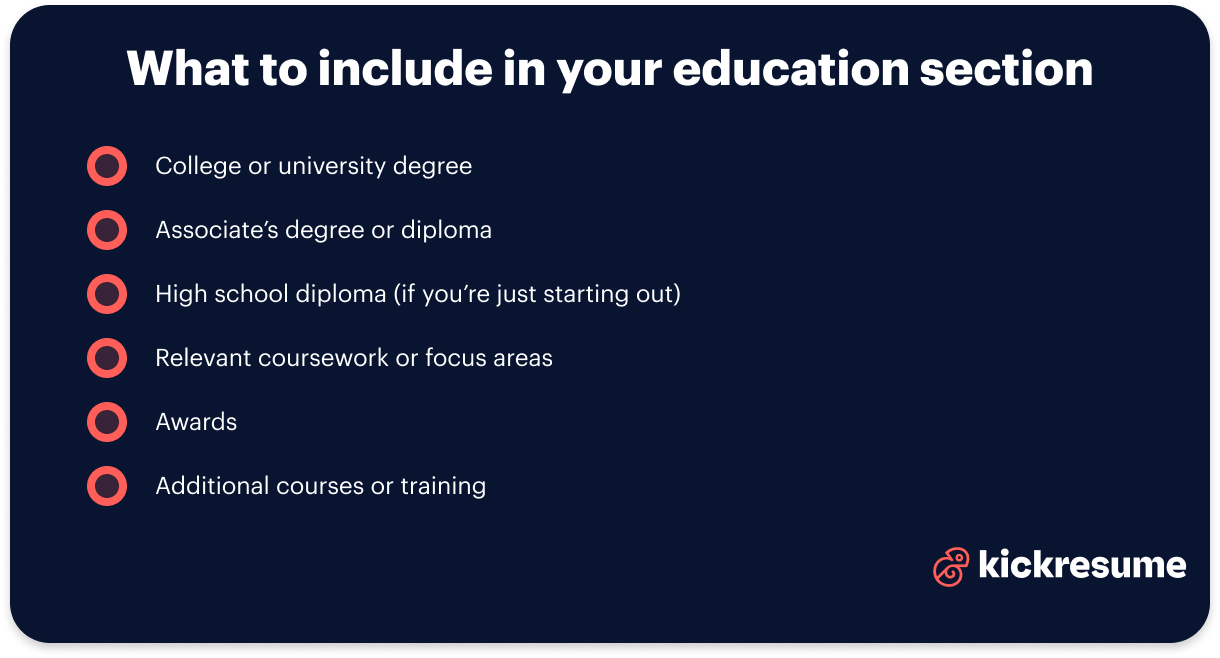
What to include in the education section
Here’s what typically belongs on an interior designer’s resume:
- College or university degree: Interior Design, Interior Architecture, Architecture, Environmental Design, Fine Arts, or a related discipline
- Associate’s degree or diploma: Interior Design, Architectural Drafting, Spatial Design, or similar programs
- High school diploma: Usually only relevant if you’re a student or recent graduate and have limited professional experience
- Relevant coursework or focus areas: Space planning, materials and finishes, lighting design, building codes, CAD drafting, sustainability, or furniture design
- Additional courses or training: Software training (AutoCAD, SketchUp, Revit), color theory, lighting workshops, or design certifications
Education section example for an interior designer resume
Bachelor of Fine Arts in Interior Design
Savannah College of Art and Design (SCAD), Savannah, GA
2019 – 2023
Relevant coursework: Space Planning, Materials & Finishes, Lighting Design, CAD Drafting, Sustainable Design
Interior Design Certificate Program
Online Design Academy
2024
Focused on residential layouts, client presentations, and project documentation
If you’re still studying or recently graduated
If you don’t have much professional experience yet, your education section can do more of the heavy lifting.
In that case, it’s perfectly fine to:
- Place Education above Work Experience
- Highlight studio projects, thesis work, or design concepts
- Mention tools you used during your studies (AutoCAD, SketchUp, Adobe Creative Suite, etc.)
This helps employers understand what you’ve already worked on, even if it wasn’t in a paid role.
What if you don’t have a formal interior design degree?
That’s not a deal-breaker. Many interior designers enter the field through adjacent disciplines or hands-on experience.
If you don’t have a traditional degree, lean more heavily on:
- Design diplomas or certificate programs
- Software and technical training
- Workshops, short courses, or continuing education
- A strong portfolio that demonstrates your design thinking
Even short, focused programs can signal commitment, curiosity, and professional growth, which are all qualities design studios value highly.
8. How to pick relevant optional sections for an interior designer resume
Once you’ve covered the essentials (summary or objective, skills, work experience, and education), you can decide whether to add optional resume sections.
These sections can help you stand out, but only if they add real value to your design profile.
Interior design resumes benefit from optional sections more than many other professions, because they allow you to highlight creativity, specialization, and hands-on experience that may not fit neatly into standard job descriptions.
Add optional sections if:
- You’ve completed design certifications, courses, or specialized training
- You’ve worked on notable projects (academic, freelance, or professional)
- You use industry-standard design tools and software
- You’re a student or junior designer and need to strengthen your resume beyond limited work experience
Skip optional sections if:
- You’re only trying to fill space
- The information doesn’t relate to interior design or spatial work
- The achievements are outdated or irrelevant to the role
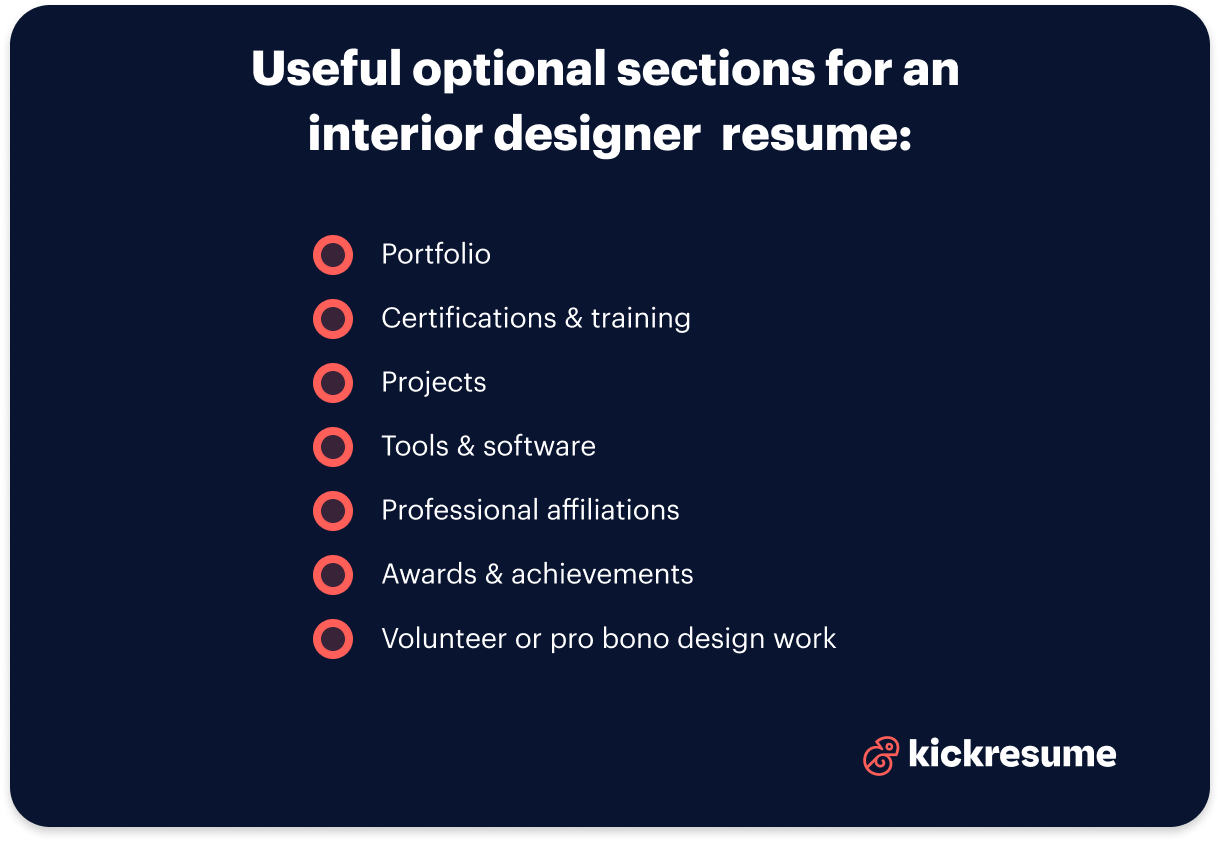
Useful optional sections for an interior designer resume
Portfolio (highly recommended)
Your portfolio is often more important than your resume in interior design roles.
You can include:
- A direct link to your online portfolio or website
- A short list of selected projects with brief descriptions
- Academic studio projects if you’re a student or recent graduate
Tip: Always make sure your portfolio link is clearly visible and working.
Certifications & training
These help validate your technical and professional skills, especially if you’re early in your career.
Examples include:
- Interior Design Certification Programs
- AutoCAD, SketchUp, or Revit certifications
- Sustainable design or LEED-related training
- Lighting design or materials & finishes workshops
Projects
A dedicated Projects section works well for:
- Students
- Junior designers
- Freelancers
You can include:
- Residential or commercial design projects
- Studio work or capstone projects
- Concept designs or competition entries
Focus on your role, the design challenge, and the outcome, not just aesthetics.
Tools & software
Interior design is highly tool-driven, so this section is often very valuable.
Common tools include:
- AutoCAD
- SketchUp
- Revit
- Adobe Creative Suite (Photoshop, Illustrator, InDesign)
- 3D rendering tools (V-Ray, Enscape, Lumion)
List only tools you’re genuinely comfortable using.
Professional affiliations
Memberships can signal commitment to the profession.
Examples:
- American Society of Interior Designers (ASID)
- International Interior Design Association (IIDA)
- Local design or architecture associations
Awards & achievements
Awards and achievements can help you stand out, especially as a student or early-career designer.
Examples:
- Design competition awards
- Academic honors
- Studio project recognitions
- Client or firm awards
Volunteer or pro bono design work
Volunteer design work is absolutely relevant if it involved real design responsibilities.
Examples:
- Community space redesigns
- Non-profit or charity interiors
- Event or exhibition design
Example of optional sections on an interior designer resume
Certifications
AutoCAD Professional Certification, 2023
Interior Design Certificate, Online Design Institute, 2024
Selected projects
Residential Apartment Redesign — Concept & Space Planning
Commercial Office Fit-Out — Lighting Design & Material Selection
Use optional sections strategically. A few well-chosen additions can strengthen your profile and highlight your design strengths, without making your resume feel cluttered or unfocused.
Always ask yourself:
Does this section help a studio, firm, or client understand how I design and work?
9. How to avoid mistakes when creating an interior designer resume
You’ve put time and creativity into your portfolio, projects, and design education. You understand layouts, materials, and aesthetics.
Don’t let avoidable resume mistakes undermine all of that.
Below are the most common pitfalls interior designers make on their resumes, and how to avoid them.
- Typos and careless errors: In design roles, attention to detail is non-negotiable. Small spelling or grammar mistakes can signal sloppiness, even if your design skills are strong.
- How to avoid it: Proofread carefully, read your resume aloud, and use spell-check tools. If you want an extra layer of confidence, professional proofreading can help catch details you might overlook.
- Over-designed or hard-to-read layouts: While interior design is a visual profession, your resume is not the place to experiment with complex layouts, decorative fonts, or heavy graphics.
- How to avoid it: Keep your resume clean and structured. Use clear section headings, consistent spacing, and readable fonts. Your portfolio can show creativity — your resume should show clarity and professionalism.
- Using the same resume for every design role: Residential studios, commercial firms, hospitality design, and corporate interiors all value slightly different skills.
- How to avoid it: Tailor your resume to each job posting. Mirror keywords from the description (e.g. space planning, FF&E selection, AutoCAD, client presentations) and highlight the most relevant projects. Resume tailoring tools can make this process faster and more precise.
- Listing tasks instead of design impact: Saying you “worked on projects” or “assisted with design tasks” doesn’t show your value.
- How to avoid it: Focus on outcomes and contributions. For example: Improved client satisfaction, Delivered projects on time and within budget, Supported senior designers on multi-phase projects, Contributed to successful client presentations or approvals
- Forgetting to quantify your work: Design work often can be measured — candidates just forget to do it.
- How to avoid it: Whenever possible, add numbers: Project budgets handled, Number of projects or clients, Square footage designed, Timelines reduced or deadlines met
- Ignoring soft skills that matter in design: Interior designers don’t work in isolation. Communication, collaboration, and client-facing skills are essential.
- How to avoid it: Highlight skills like client communication, teamwork, time management, and problem-solving — especially if you’ve worked with contractors, suppliers, or cross-functional teams.
- Outdated or unprofessional contact details: This sounds basic, but it still happens.
- How to avoid it: Double-check your email address, phone number, and portfolio link. One typo can prevent a studio or recruiter from contacting you.
- Missing keywords for ATS screening: Many design firms and agencies use ATS software to filter applications.
- How to avoid it: If the job ad mentions tools or skills like AutoCAD, SketchUp, Revit, space planning, lighting design, or FF&E — and you have them — include them clearly on your resume.
- Adding irrelevant or distracting information: Unrelated part-time jobs from years ago or hobbies that don’t support your design profile can dilute your message.
- How to avoid it: Keep your resume focused on design-related experience, education, and skills. Aim for relevance, not filler — and ideally, one clean page for junior and mid-level designers.
Take one final pass through your resume with these mistakes in mind. Fixing them takes only a few minutes, but it can significantly improve how polished, professional, and credible you appear as an interior designer.
10. How to create a complementary and matching cover letter for your interior designer resume
A resume shows what you’ve done.
A cover letter explains how you design, and why that matters.
While your resume focuses on roles, projects, and skills, your cover letter gives you space to add context and personality to your application.
This is where you can:
- Explain your design approach and creative process
- Highlight how you collaborate with clients, teams, and contractors
- Show genuine interest in this specific studio, firm, or design style
What should an interior designer cover letter do?
A strong interior designer cover letter should clearly answer:
- Who are you as a designer (your focus, style, or specialization)?
- Why are you interested in this particular firm, studio, or project type?
- What relevant experience or projects have you worked on before (with 1–2 concrete examples)?
- How will your skills support the team’s design goals and client needs?
Instead of repeating your resume bullet points, use the cover letter to add narrative and insight.
Example upgrade
In my recent role, I supported residential and hospitality projects from concept to final installation, collaborating closely with senior designers, suppliers, and clients. I contributed to space planning, FF&E selection, and client presentations, helping deliver projects on time and aligned with the client’s vision. I’d be excited to bring this collaborative, detail-driven approach to your studio, especially on projects that emphasize sustainable and human-centered design.
How is a cover letter different from a resume?
- Resume: Structured into sections (Experience, Skills, Education), built around bullet points, tools, and project details.
- Cover letter: 4–6 short paragraphs written in a narrative style, focused on motivation, fit, and design thinking.
Your resume proves you can do the work.
Your cover letter shows how you think, how you work with others, and why this role excites you.
Make your resume and cover letter look like a cohesive set
Visual consistency matters in design-focused roles, as it subtly signals professionalism and attention to detail.
To keep your application aligned:
- Use the same header: Name, email, phone number, and portfolio link should match exactly on both documents.
- Keep fonts consistent: If your resume uses a clean, modern font, mirror it in your cover letter.
- Align layout and spacing: Similar margins and spacing make the documents feel intentional.
- Use accent colors sparingly: If your resume includes a subtle accent color, echo it lightly in the cover letter, but keep readability the priority.
- Use matching templates: For example, Kickresume’s resume templates come with matching cover letter designs, so both documents look polished and unified.
When your resume template and cover letter template clearly belong together, your application feels more professional, thoughtful, and trustworthy. That is exactly the impression interior design employers look for.
Create your cover letter fast with artificial intelligence.

11. Where to find the best resources for job-seeking interior designers
Whether you’re applying for your first junior interior designer role, moving from a studio assistant position to a full interior designer role, or transitioning into a more specialized area (residential, commercial, hospitality), knowing where to look can significantly speed up your job search.
Below are some of the most useful resources interior designers rely on when searching for new opportunities.
General job boards
These platforms list thousands of design-related roles across studios, firms, and in-house teams:
- Indeed: One of the largest job boards globally, with frequent listings for interior designers, junior designers, design assistants, and space planners. Filters allow you to narrow roles by location, experience level, and industry.
- LinkedIn Jobs: Particularly valuable for design roles, as many studios post openings directly and actively review profiles and portfolios.
- Glassdoor: Useful not only for job listings, but also for salary insights, company reviews, and interview feedback from other designers.
- ZipRecruiter: Offers interior design listings with quick-apply features and estimated salary ranges.
Design and architecture-specific job boards
If you want to avoid unrelated roles and focus purely on design-focused opportunities, these niche platforms are especially helpful:
- Archinect Jobs: A go-to platform for architecture and interior design roles, internships, and studio positions worldwide.
- Dezeen Jobs: Highly respected in the design industry, featuring roles at well-known studios, architecture firms, and creative agencies.
- DesignJobsBoard: Covers interior design, furniture design, spatial design, and related creative disciplines.
- Interior Design Jobs (InteriorDesign.net): Focuses on interior design roles across residential, commercial, and hospitality sectors.
- Arts Thread / Creative Jobs platforms: Useful for junior designers, graduates, and early-career creatives.
Design studios & firm career pages
Many interior design studios prefer to post openings directly on their own websites or social channels before advertising broadly.
If you already have target studios or firms in mind, check:
- Interior design studio websites (often under “Careers” or “Join Us”)
- Architecture firms with interior design departments
- Hospitality design firms
- Furniture brands and design manufacturers
- Real estate developers with in-house design teams
Pro tip: Even if no role is listed, speculative applications with a strong portfolio and tailored cover letter are common, and often successful, in the design industry.
Networking & design communities
Interior design hiring is highly relationship-driven. Networking can open doors long before a job is publicly advertised.
Consider:
- Joining interior design groups on LinkedIn
- Following studios, creative directors, and senior designers on social media
- Attending design fairs, exhibitions, and industry events
- Engaging in online design communities and forums
- Reaching out to alumni from your design school or university
A short, thoughtful message paired with a portfolio link can often lead to informal conversations, and future opportunities.
Continuous learning & specialization
Upskilling is a powerful way to stand out, especially in competitive design markets.
Interior designers can strengthen their profiles through:
- Advanced software training (AutoCAD, SketchUp, Revit, Rhino, Adobe CC)
- Rendering and visualization courses
- Sustainable design and materials certifications
- Lighting design or FF&E specialization
- Project management or client communication training
While certifications aren’t always required in interior design, targeted learning signals ambition, adaptability, and long-term commitment to the profession.
Job searching in interior design can feel overwhelming, especially early in your career, but the right mix of job boards, networking, and a polished resume + portfolio can make the process far more effective. Pair these resources with a tailored interior designer resume and cover letter, and you’ll be one step closer to your next design role.
Art / Design Career Outlook in 2026
Art and Design occupations are projected to grow slower than the average for all occupations between now and 2034 (Source: U.S. Bureau of Labor Statistics).
Even with below-average growth projections, approximately 84,900 Art and Design positions are expected to become available annually.
According to a Figma survey, more than 80% of designers say learning to work with AI will be essential to success in their role in the future.
For 2026, this means employers are prioritizing designers who can art-direct AI outputs and translate business goals into visual strategy rather than just execute layouts.
Average US base salaries across popular Art / Design roles:
- Art Director: $94,898/year
- Copywriter: $72,821/year
- Graphic Designer: $63,196/year
- Interior Designer: $73,033/year
- Photographer: $51,412/year
- Product Designer: $138,769/year
- Video Editor: $79,249/year
These salary estimates come from Indeed (as of January 2026), and are based on anonymous submissions from workers, along with salary data from job postings on the platform over the last 36 months. Exact figures vary by location, company size, and experience level.
All in all, if you’re thinking about starting a career in art and design or advancing within the field, it still offers solid opportunities for creatives with strong skills and a clear sense of direction.
Interior Designer Resume FAQ
Should I include a portfolio link on my interior designer resume?
Yes, and always, if you have one.
A portfolio is one of the most important parts of an interior designer’s application. Include a clickable link to your online portfolio (or Behance / personal website) directly in your resume header. Make sure it showcases real projects, clear visuals, and brief explanations of your role in each project.
How long should an interior designer resume be?
In most cases, one page is ideal, especially for junior and mid-level interior designers.
If you have 10+ years of experience, multiple large projects, or senior roles, a two-page resume is acceptable, but only if every section adds clear value. Hiring managers prefer concise resumes that highlight your strongest work, not a full career archive.
What skills should I put on an interior designer resume?
Focus on a mix of technical (hard) skills and creative or interpersonal (soft) skills, tailored to the job description.
Commonly requested skills include space planning, AutoCAD, SketchUp, Revit, material selection, lighting design, client communication, and project coordination. Avoid listing every tool you’ve ever touched, as relevance matters more than quantity.
Is creativity or ATS-friendliness more important for an interior designer resume?
You need both, but in the right balance.
While interior design is a creative field, many companies still use ATS software to screen resumes. That means your resume should use clean formatting, standard section headings, and readable fonts, while expressing creativity through content and portfolio, not layout complexity. Save bold visuals for your portfolio, not your resume structure.
But at the end of the day, the choice is yours. Feel free to browse through Kickresume's creative templates, ATS-friendly templates, or other resume templates to choose the one that suits you the best.
How do I write an interior designer resume with little or no experience?
If you’re a student or junior designer, shift the focus away from job titles and toward education, internships, academic projects, and studio work.
You can include coursework, conceptual projects, volunteer design work, or freelance collaborations. Use bullet points to explain what you designed, which tools you used, and what problem you solved, even if the project wasn’t commercial.
We have a detailed article on how to write a great resume with no experience for you to read.
Should interior designers use a resume summary or a resume objective?
It depends on your experience level.
If you already have professional experience, a resume summary works best, as it highlights your expertise and past projects.
If you’re just starting out or changing careers, a resume objective is often a better choice, as it explains your goals and the value you want to bring to the role.




![How to Write a Professional Resume Summary? [+Examples]](https://d2xe0iugdha6pz.cloudfront.net/article-small-images/How_to_Write_a_Professional_Resume_Summary_.png)

![How to Describe Your Work Experience on a Resume? [+Examples]](https://d2xe0iugdha6pz.cloudfront.net/article-small-images/How_to_Describe_Your_Work_Experience_on_a_Resume_.png)